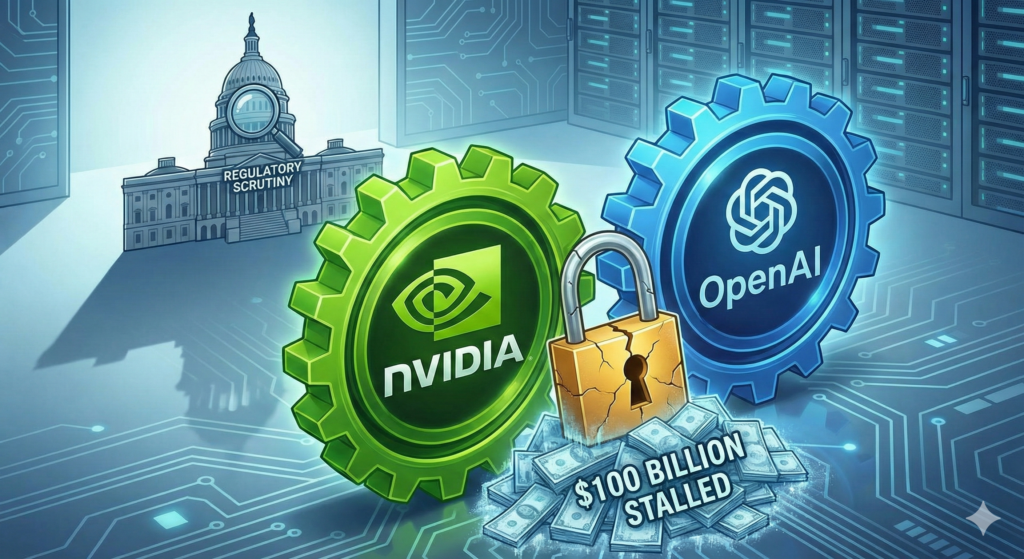
The AI arms race just hit a massive speed bump. For months, the tech world has been buzzing about a seismic shift in Silicon Valley: a reported $100 billion investment plan involving Nvidia and OpenAI. However, a recent WSJ report suggests that this historic deal has officially stalled.
As the two titans of the AI era—Nvidia (the hardware king) and OpenAI (the software pioneer)—navigate this friction, the implications for the broader market are massive. Is the AI bubble finally showing cracks, or is this simply a regulatory “timeout”?
>  Key Takeaways: TL;DR
Key Takeaways: TL;DR> * The Stall: Nvidia’s planned multi-billion dollar injection into OpenAI is reportedly on ice following concerns over valuation and “circular financing.”
> * Regulatory Heat: Increased scrutiny from the FTC and DOJ regarding “Big Tech” antitrust issues is making massive cross-investments riskier.
> * Market Impact: The stall follows a volatile week for AI stocks, including a significant market cap wipeout for Microsoft linked to its OpenAI exposure.
> * Strategic Shift: OpenAI is now looking toward a diverse syndicate of investors, including Amazon and SoftBank, to bridge the capital gap.
>
Why the Nvidia OpenAI Investment is Stalling
According to the WSJ report, the negotiations have hit a wall for three primary reasons:
1. The “Circular Financing” Controversy
Critics and regulators have begun labeling these deals as “financial theater.” The concern is that Nvidia invests billions into OpenAI, which OpenAI then immediately spends to buy Nvidia’s GPUs. This creates a loop where revenue is inflated without “real” external economic growth. Following the recent Microsoft market crash, investors are becoming wary of these closed-loop accounting practices.
2. Antitrust and Regulatory Scrutiny
The DOJ and FTC have intensified their investigations into the “AI Cartel.” If Nvidia—which already controls over 90% of the data center GPU market—becomes a lead investor in the world’s most prominent AI lab, regulators fear it could create an unbreakable monopoly. Avoiding a formal antitrust block is likely a major reason for the current hesitation.
3. Valuation Discrepancies
OpenAI is currently seeking a valuation that could push it toward the $1 trillion mark. While Jensen Huang (Nvidia CEO) has expressed immense confidence in “generational companies,” the sheer scale of the $100 billion figure requires a level of due diligence that is proving difficult to finalize amidst shifting market conditions.
Strategic Impact: What This Means for the AI Industry
The stalling of this deal isn’t just a headline—it changes the board for every player in the industry.
For Nvidia’s Dominance
Nvidia doesn’t need to invest to sell chips; demand for the Blackwell GPUs is already at an all-time high. However, an investment would have guaranteed that OpenAI remained locked into Nvidia’s ecosystem. If the deal fails, it opens the door for OpenAI to potentially diversify its hardware stack with competitors like Cerebras or AMD.
For OpenAI’s Ambitions
Sam Altman has made it clear that “AGI” (Artificial General Intelligence) requires astronomical levels of capital—specifically for the Stargate project and massive data center expansions. Without Nvidia’s $100 billion, OpenAI must lean harder on partners like Microsoft, Amazon, and SoftBank to maintain its lead over rivals like Anthropic and Meta.
Industry Context: The Rivalry Heats Up
While the Nvidia deal hangs in the balance, other “Big Tech” players are moving in:
* Amazon: Reportedly in talks for a massive $50 billion stake to boost its AWS cloud dominance.
* Microsoft: Already $13 billion deep, Microsoft is trying to balance its partnership without further spooking its own shareholders.
* SoftBank: Masayoshi Son has recently injected billions, though he recently scrapped a separate $50 billion deal for data center provider Switch, showing that even the biggest spenders are becoming more selective.
Frequently Asked Questions (FAQ)
Q: Did Nvidia officially cancel the investment?
A: No. According to current reports, the deal has “stalled,” meaning negotiations are paused or significantly slowed, but not necessarily dead.
Q: What is “Circular Financing” in AI?
A: It refers to a situation where a chipmaker (like Nvidia) or cloud provider (like Microsoft) invests in an AI startup, and that startup uses the funds to buy products or services back from the investor.
Q: Will this affect ChatGPT’s performance?
A: Not directly. However, if OpenAI cannot secure the necessary capital for infrastructure, it could slow down the training of future models like GPT-6 or the full rollout of Sora.
Final Thoughts: Is the AI Bubble Bursting?
The stalling of the Nvidia OpenAI investment signals a transition from “growth at any cost” to a more scrutinized, “show me the value” phase of the AI revolution. For developers and tech enthusiasts, this might actually be a positive—forcing more transparency and sustainable business models in the race for AGI.
What do you think? Is Nvidia right to be cautious, or is this just a temporary hurdle in an unstoppable trend?